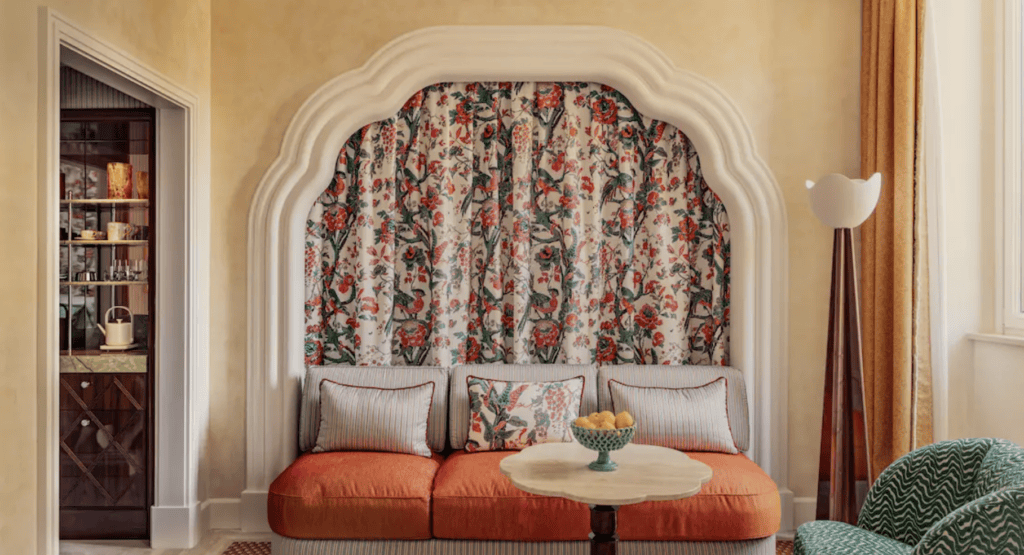
Most people choose a hotel based on location and reviews. What they’re less likely to factor in is the design of the space they’re about to spend several days inside and what that design will do to how they experience the city around it.
Casa Monti Rome makes the argument with gusto: where you stay dictates your trip. Everything in the building, from the floors to the rooftop bar to the napkin on your aperitivo table, draws from the same source and holds the same intention. The result is a property that doesn’t just sit in Rome. It belongs to it. And the difference between those two things, for a guest, is the difference between a comfortable base and a trip that truly lets you live within the city (without giving up the comforts of a luxury hotel).
What a Considered Space Does to Your Trip
There is a body of research in environmental psychology – the field studying how physical spaces affect behavior and mood — that rarely gets mentioned when people are deciding where to stay. The short version: a coherent, intentional space produces measurable effects. Stress responses lower. Your attention shifts from low-grade scanning for something that feels off, to something more focused and absorbing. You notice more. You feel more present.
There is a category of large luxury hotel that has built its model around consistency. You know what you’re getting: the room will be a certain size, the service will follow a certain protocol. That model has real value, particularly for work travel or moving quickly through multiple cities. Understanding why fewer decisions produce better travel is part of why those hotels exist and why they work.
But if you’re traveling to actually inhabit Rome, to let the city change how you think and what you notice, that consistency becomes a ceiling. When a hotel could exist anywhere, it doesn’t fully exist where you are. The gap between the space you’re sleeping in and the city you came to see is a gap your trip has to cross every morning when you step outside.
Casa Monti has no such gap.
What Casa Monti Gets Right About Design
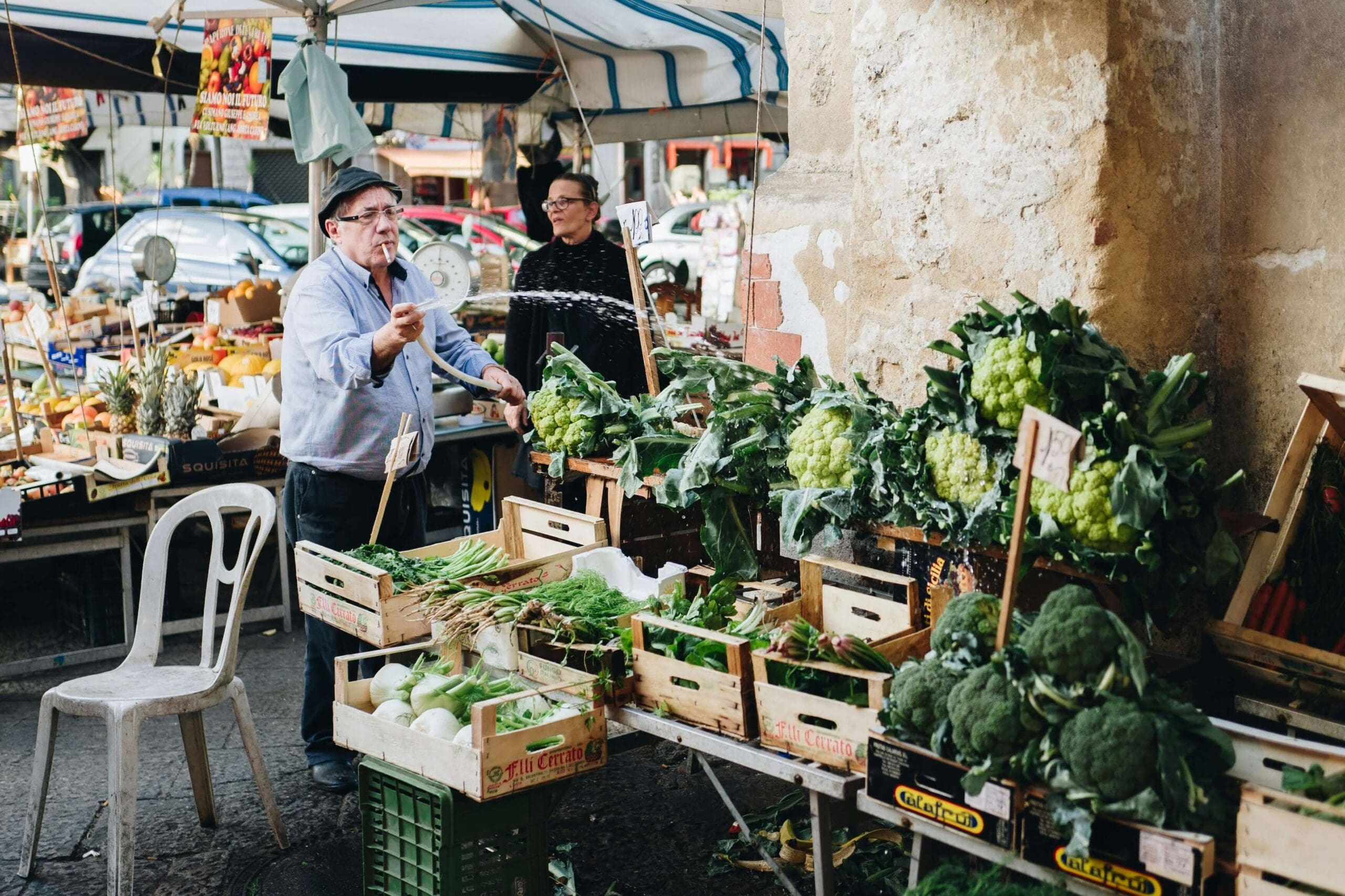
The hotel sits on Via Panisperna in Monti, one of Rome’s oldest neighborhoods, the ancient Subura where Julius Caesar spent his early years. Today it’s antique shops, small galleries, family-run osterias, and bookshops that haven’t changed their stock in decades. The building itself, whose 19th-century facade is classified as a historic monument, is at the center of all of it. This is the part of Rome that often gets missed when a trip is over-programmed with highlights. It’s worth understanding what gets lost when a city trip is over-programmed before you book.
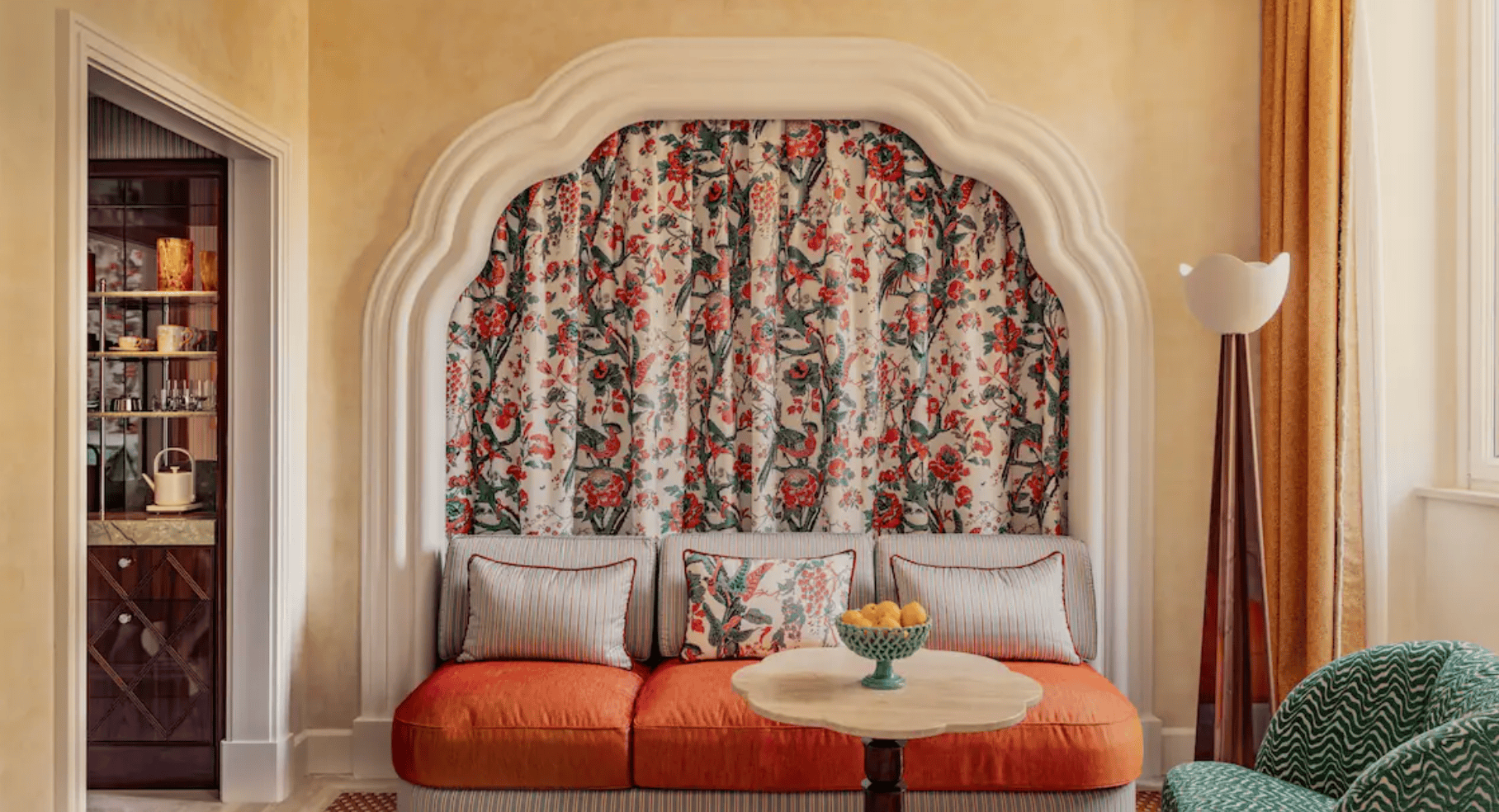
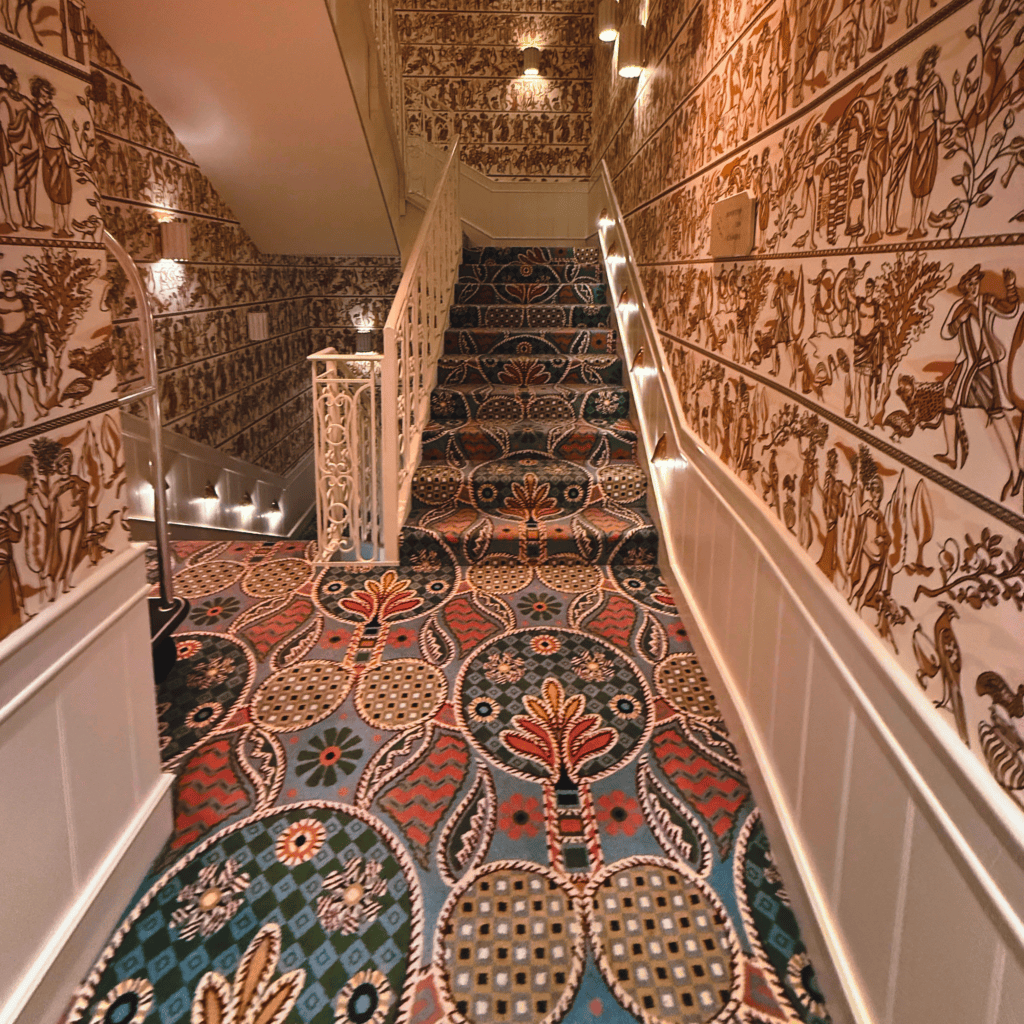
French designer Laura Gonzalez drew the hotel’s design vocabulary entirely from Rome. The floors are terrazzo, laid in a grid pattern modeled on the floors of Roman Pompeii. Mosaics appear throughout — above bathtubs, set into panels, across the rooftop bar — because mosaic is woven through 2,000 years of Roman visual history. The color palette comes from what you actually see when you look at this city: terracotta rooftops, the specific blue of a Roman autumn sky, the deep greens of Villa Borghese in late afternoon.
Gonzalez worked with local Roman artisans throughout, marble workers, mosaic artists, woodworkers, many from workshops operating for generations. The result is a building that has texture in the literal sense: the small variations of a hand-made tile, the weight of hand-forged brass, the particular quality of hand-painted plaster. These differences are subtle and cumulative. By the time you’ve moved through the lobby, the restaurant, the stairs, and the rooftop, the sum of them adds up to something you feel before you can name it.
The stairs are worth noting: most hotels treat them as utility space. At Casa Monti they are a designed space, another room worth being in. Nothing was left to just function.
When Nothing Is Left to Default
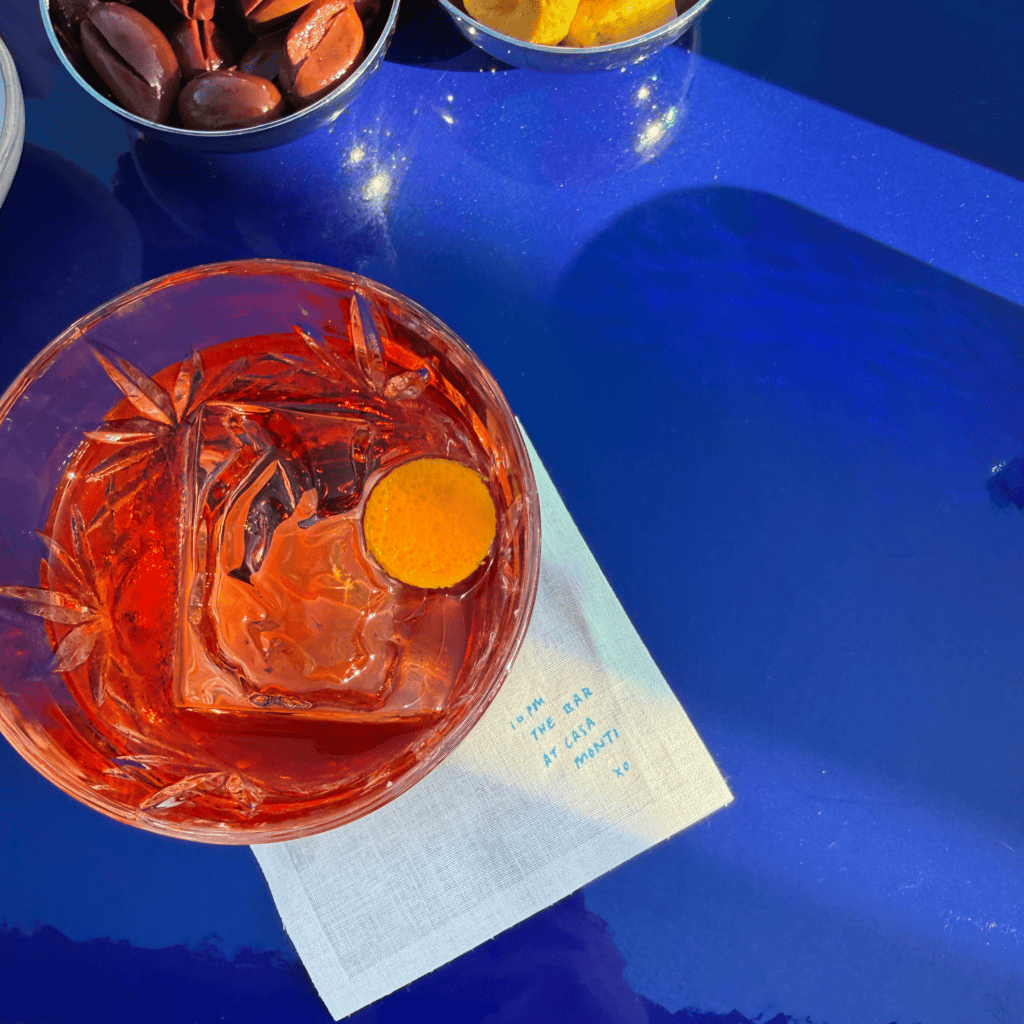
At Casa Monti, the bar napkin was designed. The matchbook was designed. The candles on the bar were the right color. The aperitivo glass had weight to it. Every object within reach at the rooftop bar was, unmistakably, part of the same conversation as the frescoes in the lobby below, the mosaic in the bathroom, the terrazzo in the corridor. The decision-making extended all the way to the edges of the experience. Nothing was left to default.
Most hotels make a strong statement at the scale of the lobby and then allow it to thin out as the objects get smaller. The room is good. The bathroom is good. The soap is fine. The napkins are napkins. The design logic runs out somewhere around the complimentary amenity basket.
At Casa Monti, someone thought carefully about the napkin before they specified it. This is part of what the best trips tend to share — not a list of highlights, but the quality of the attention that went into building them.
The staff uniforms follow the same logic. Each role has its own, subtly different, specific to where in the hotel that person works, drawn from the same visual palette as everything around them. When you encounter the rooftop bar staff, they are of the rooftop bar. Great design and great hospitality come from the same intention.
What Else to Know Before Booking Casa Monti Rome
The spa is a Susanne Kaufmann spa, the only one in Rome. Three treatment rooms with amber lighting, mosaic-lined walls hand-drawn by local artists, and a marble jacuzzi. It accommodates one guest at a time. That is a design decision as much as a service one: the same intention that went into the napkin went into the spa schedule.
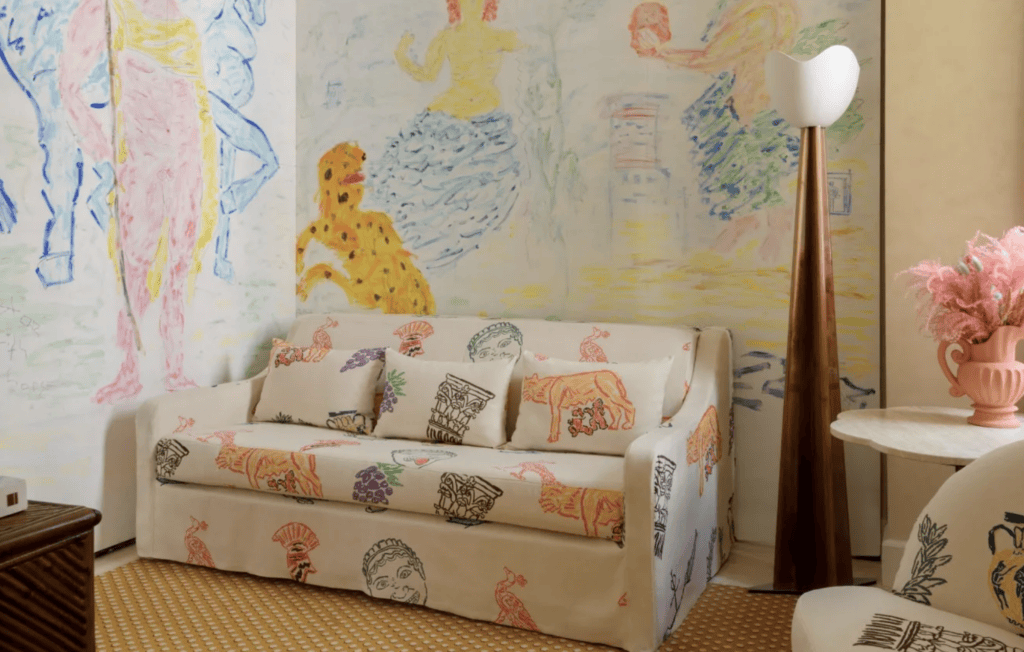
The artist in residence program reflects the hotel’s ongoing commitment to supporting and elevating contemporary artists’ work. The hand-painted lobby frescoes were commissioned from a Roman artist and exist as works in their own right. Art here is not an accent. The hotel is still in active conversation with the creative community.
Getting around: parked outside is a vintage Fiat 500, available for guided tours through Rome. Suite guests have complimentary use of a Microlino — the Italian electric microcar — for independent exploring. It’s a designed object: compact, forward-looking, entirely at home on a Roman street. You don’t leave the hotel’s logic when you leave the hotel.
Why It Matters Which Hotel You Choose
The hotel you stay in shapes how you travel, whether or not you’re thinking about design. A space that is coherent and specific to its place gives you a frame for the city. After a night at Casa Monti, you leave each morning having already absorbed something of Rome and that changes what you find when you go looking.
If you’re planning a trip to Italy and want help thinking through where to stay and why it matters, that’s exactly the kind of question worth working through with a travel advisor. The logistics are manageable. The judgment calls, the ones that determine whether a trip is good or exceptional, are where experience makes the difference.
If you’d like to stay current on properties worth knowing, hotels I’ve visited, and how I think about travel design, the newsletter is a good place to start.