There’s a particular kind of family trip that’s harder to plan than it sounds. Not the beach week or the theme park, those have solved logistics and predictable outcomes. The hard one is the trip that’s supposed to stand out; The one a grandparent has been thinking about for years, that teenagers might actually remember, that doesn’t split along age lines where half the group is overwhelmed and the other half is bored.
Most destinations fail this test in at least one way. Safari is logistically complex for grandparents with limited mobility. European city trips are hard on anyone who doesn’t want to walk eight miles a day. Adventure itineraries exclude people at both ends of the age range. The multi-generational Galapagos cruise keeps coming up in my practice as the exception, not because it’s been packaged as a family trip, but because of the destination.
The wildlife doesn’t run from you. The park system keeps groups small. And the expedition format is divided by activity level rather than by age. Those three things together solve a problem that most destinations can’t.
What the Galapagos Does That Almost No Other Destination Can
The wildlife doesn’t move away from you
The animals in the Galapagos evolved on islands with no mammalian predators. They never developed a fear of humans. This isn’t a tourism enhancement, it’s an evolutionary reality that has been protected by Ecuador’s national park regulations for decades, and it’s the structural fact that makes a multi-generational trip here work in a way that wildlife destinations elsewhere simply don’t.
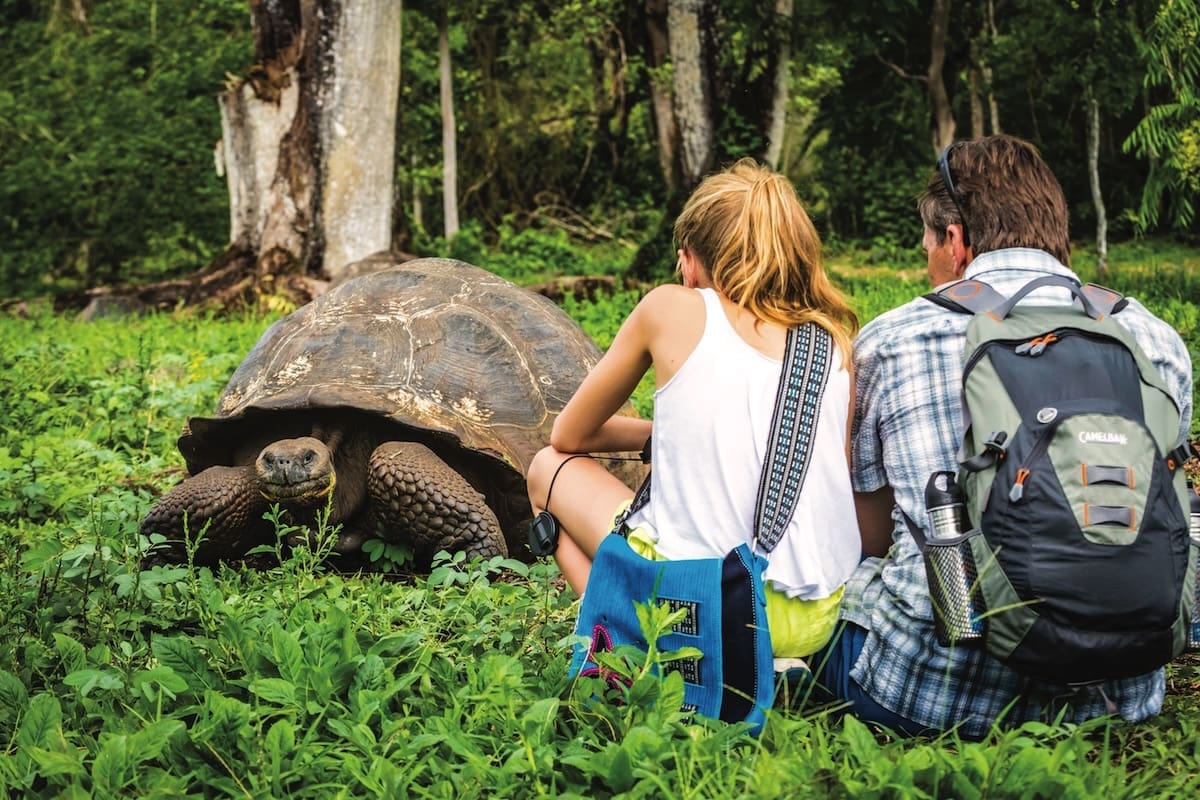
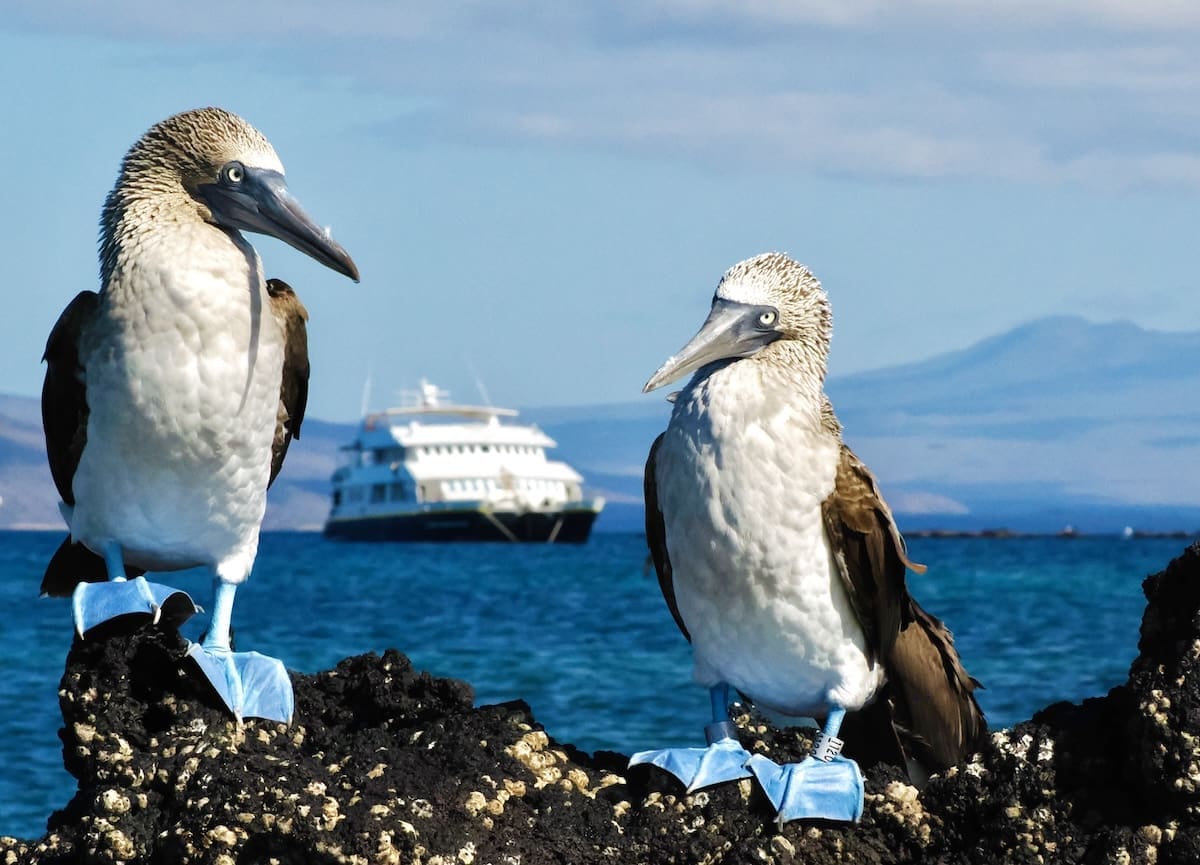
A blue-footed booby will perform its courtship dance three feet from the trail. Marine iguanas pile up on lava rocks within arm’s reach and stay there regardless of who’s watching. Giant tortoises, some of them well over a century old, graze in open meadows while naturalist guides explain the differences between island populations. None of this requires speed, stamina, a particular fitness level, or an early start to witness.
A twelve-year-old and a seventy-eight-year-old stand on the same trail and have exactly the same encounter. That’s not possible in most wildlife destinations, where access is often proportional to how hard you’re willing to push. In the Galapagos, it’s just the destination.
The park system keeps the experience intact
Ecuador’s national park regulations cap the number of visitors at each landing site regardless of the ship’s size. You’re not competing with a thousand other passengers for the same stretch of beach. On an expedition ship of 80 to 100 guests, you land in small groups with a naturalist who knows everyone’s name and everyone’s pace by the end of day one.
The absence of crowds here is regulatory, not incidental. The Galapagos National Park controls access in ways that most destinations can’t or don’t, and that control is part of what makes the trip hold for a mixed-age group. Nobody is being herded. Nobody is waiting in a line that stretches around a corner.
How Activity Levels Actually Work on the Ship
The groups divide by pace, not by age
Most expedition operators in the Galapagos split excursion groups by activity level on each landing: a longer, faster hike to one site versus a shorter, slower-paced walk to the same or an adjacent site. The family doesn’t have to split by who can keep up; they split by what they want to do that morning. They reunite at the Zodiac, compare notes, and have a real conversation about different versions of the same place. That’s a better dinner conversation than most trips can deliver.
The expedition format is built around this kind of flexibility. It’s how small-ship cruising works in a way that larger ships can’t replicate: the naturalist team knows the group, reads the energy, and adjusts. Nobody is the limiting factor. Nobody feels like they’re holding anyone back.
What grandparents should know before booking
This is the conversation we will have before the deposit is placed, not after. Expedition ships in the Galapagos have stairs and no elevators. Zodiac boarding requires stepping in and out of an inflatable craft with crew assistance which is manageable for most, but worth understanding in advance. Walking terrain on the islands ranges from flat and packed to uneven volcanic rock. The realistic benchmark is being able to walk one to two kilometers on sometimes uneven ground.
None of that disqualifies most grandparents. Walking sticks are available on trails, crew members are trained to assist at Zodiac boarding points, and the activity split means slower-paced options exist for every landing. What it does require is an honest conversation upfront about where someone is physically; the kind of assessment that shapes which ship, which itinerary, and which departure makes sense. Wheelchairs are not accommodated on expedition vessels. That’s the one clear line, and it’s worth establishing early.
Clients who go in clear-eyed about what the trip involves come home saying it was the best thing their family has ever done together.
What Lindblad Does for Multi-Generational Groups
The fleet and what’s changed
My preferred supplier for most expedition cruising, and the Galapagos in particular, is Linblad Expeditions who has partnered with National Geographic to create truly exceptional itineraries and ships. Their Galapagos sailings are a true standout and a client favorite.
In the past few years, National Geographic–Lindblad Expeditions has expanded its Galapagos fleet from two ships to four, adding National Geographic Delfina and National Geographic Gemini to meet demand that has grown significantly. Guests under 18 increased by 24% year over year in recent seasons, and children now represent 21% of all Galapagos passengers the company carries, the highest proportion of any destination in their fleet.
National Geographic Delfina hosts 16 guests per voyage and was also built for private family charters. For families who want the Galapagos on their own terms — their own schedule flex, their own group dynamic, their own pace across every landing — this is the move. It’s the entire ship, and the entire expedition team, for one family group.
For larger multi-gen families traveling together but not chartering, National Geographic Gemini provides more cabin inventory while keeping the small-ship format intact.
Why the National Geographic partnership matters for families specifically
The National Geographic Explorers-in-Training program runs on every Lindblad Galapagos departure. It’s structured programming for kids and teenagers, not just the option to sit in on an adult naturalist lecture, but age-appropriate education led by specialists who know how to hold a fifteen-year-old’s attention when a marine iguana is six feet away.
This is the piece that makes the trip land differently than it otherwise would for younger travelers. When a National Geographic scientist explains why the marine iguana evolved to swim (the only ocean-going lizard on earth) the answer carries more weight than a science book in their classroom at home. Certified photo instructors on every voyage give teenagers and adults alike a reason to put the phone away and actually look through a lens.
The result is a trip where the grandparent and the grandchild are in the same conversation, not parallel versions of it.
The Logistics, Addressed Plainly
How the trip is structured
Lindblad’s Galapagos itineraries run Saturday to Saturday, structured to align with airlift from Quito and Guayaquil on LATAM and Avianca. Airport transfers are included in the booking. Hotel nights on the mainland, typically Quito or Guayaquil on either end, are handled as part of the same package rather than left to the family to coordinate independently.
You land in Ecuador, you’re met, and you move. For a group traveling across multiple generations and possibly multiple origin cities, that containment is significant. There’s no gap between arrival and embarkation that requires independent logistics from a group that may include an eighty-year-old who’s just crossed several time zones.
When to book, and why it matters more for a multi-gen group
The right booking window for Galapagos is 12 to 18 months out, and for multi-generational groups, the case for the earlier end of that window is stronger. A group of ten or twelve people needs enough cabin inventory on the same sailing. They need the flexibility to choose a ship that fits, whether that’s a private charter on Delfina or a sailing on Gemini with a layout that keeps the family on the same deck.
This is not a category where close-in availability consistently opens up on desirable departures. Prime cabins and the most sought-after itinerary dates go early, and they go first to returning guests and advisor-led bookings. The families who get the trip they actually wanted started the conversation a year before they sailed.
When It’s the Right Trip and When It Isn’t
What it’s right for
Milestone trips are where the Galapagos earns its reputation for multi-gen travel. Graduations, significant birthdays, landmark anniversaries; these are the occasions where a family wants a trip that will be the story they tell for the next decade, and the Galapagos lives up to the challenge. The grandparent-grandchild combination, with parents as the middle layer, is the group structure I see most often. The two ends of the generational span tend to have the strongest reactions to the destination, the child because nothing in their experience compares, the grandparent for the same reason.
Well-traveled families who want a shared experience that isn’t a compromise in either direction (not too boring, not too strenuous) find the Galapagos delivers on what the best trips actually have in common.
Being honest about what it requires
Don’t assume the Galapagos works for every multi-gen group without having the right conversation first. Mobility, flight tolerance, comfort with open-water Zodiac transfers, and realistic expectations about wildlife (no destination guarantees sightings, though the Galapagos is as close as it gets) are all worth addressing before a booking is confirmed.
The families who come back most enthusiastic are almost always the ones who went in knowing exactly what they’d signed up for. That preparation is part of what a travel advisor actually does — it’s not just building the itinerary, it’s making sure the trip and the group are actually matched before the deposit clears.
Getting It Right
The Galapagos earns the multi-generational trip because of what expedition cruising actually is, not because it’s been marketed as a family destination. The wildlife, the park system, the small-ship expedition format, the contained logistics — these are structural features of the destination and the format, not selling points layered on top.
If this is a trip your family has been circling, I’m easy to reach. Getting the ship, the itinerary, and the timing right for a multi-gen group is exactly the kind of booking that benefits from having someone in your corner before you commit. And if you want to keep thinking through it first, my newsletter covers expedition travel and related territory regularly, you can subscribe here.