Food is one of the few things that allows you to understand a place before you understand its language. You can arrive without context, without history, without the right words, and still begin to orient yourself simply by eating what the people around you eat. Long before you learn how to greet someone properly or read the rhythm of a city, your palate starts to notice patterns. What time people eat. What flavors repeat. What ingredients appear again and again. Through food, a place introduces itself without explanation.
This is why food functions as such a powerful cultural connector. It bypasses fluency and formality. Even when conversation is limited to gestures and smiles, taste carries meaning. Sweetness signals celebration. Bitterness suggests restraint or tradition. Acidity cuts through heat and abundance. You may not know the names of the dishes yet, but you can feel how they belong. Food offers an immediate intimacy, a way of participating rather than observing, because it places you inside daily life instead of standing at its edge.
Eating locally also reveals how a place organizes itself. Meals expose priorities. They show whether time is protected or compressed, whether ingredients are treated as commodities or inheritances, whether cooking is performative or practical. In this way, food becomes a map. Not of streets or landmarks, but of values. Follow it closely enough, and it leads you into the deeper logic of a culture, quietly and without resistance.
Few places demonstrate this more clearly than Sicily.
Food as Orientation in Sicily
Sicily does not reveal itself quickly. The island is dense with history, contradiction, and regional variation, and it resists tidy narratives. But food offers an immediate point of entry. Before you understand the politics, the dialects, or the pace of life, the table begins to explain how the island works.
Daily rhythm is the first lesson. Mornings begin socially and simply. Espresso is taken standing at bar counters. In warmer months, granita appears, paired with brioche, blurring the line between breakfast and dessert. These moments are brief but repeated, anchoring the day through familiarity rather than indulgence.
Midday reshapes everything. Shops close. Streets grow quiet. Lunch is not a logistical inconvenience but a pause that slows time and creates connection. This is not nostalgia or performance. It is a living structure rooted in agricultural life and climate, still respected across the island.
Evenings stretch outward again. Dinner unfolds gradually, often late, often shared. The rhythm of eating mirrors the rhythm of the land. Paying attention to this cycle teaches more about Sicily than any itinerary.
A Cuisine Shaped by Accumulation, Not Replacement
Sicilian food is often generalized as Italian, but that frame is incomplete. The island has always been a crossroads rather than a destination, shaped by successive waves of settlement and conquest that rarely erased what came before. Instead, influences accumulated.
Greek colonists in the eighth century BCE introduced wheat, olive oil, and wine, establishing the agricultural foundation that still defines the Sicilian table. Under Roman rule, Sicily became the empire’s breadbasket, its fertile land feeding cities far beyond the island itself.
The most transformative period arrived with Arab rule beginning in the ninth century. Arabs introduced citrus, sugar cane, rice, spices, dried fruits, and advanced irrigation systems that reshaped Sicily’s interior and palate. Sweet and sour flavor combinations entered the cuisine, still visible today in dishes like caponata and agrodolce preparations. Granita itself traces back to Arab sherbets, originally made using snow from Mount Etna mixed with sweet syrups.
Later rulers added further layers. The Normans largely preserved existing foodways, while Spanish rule introduced tomatoes, chocolate, peppers, maize, and other New World ingredients that quietly transformed everyday cooking. Sicily became one of Europe’s earliest examples of true fusion cuisine, not driven by novelty but by survival and adaptation.
This history is not theoretical. It appears immediately on the plate. Pasta con le sarde combines sardines from the surrounding sea with wild fennel, raisins, and pine nuts, compressing centuries of trade, migration, and agriculture into a single dish. Caponata balances bitterness, sweetness, and acidity in a way that reflects Arab influence without announcing it.
To eat in Sicily is to encounter history without commentary.
Learning Geography Through Taste
Food also teaches Sicily’s geography faster than maps. Eastern Sicily, shaped by Greek settlement and the volcanic soils of Etna, favors simpler preparations. Grilled fish, straightforward pastas, and vegetable driven dishes dominate. Pasta alla Norma, with fried eggplant, tomato sauce, ricotta salata, and basil, reflects both seasonality and abundance, tied directly to the landscape around Catania.
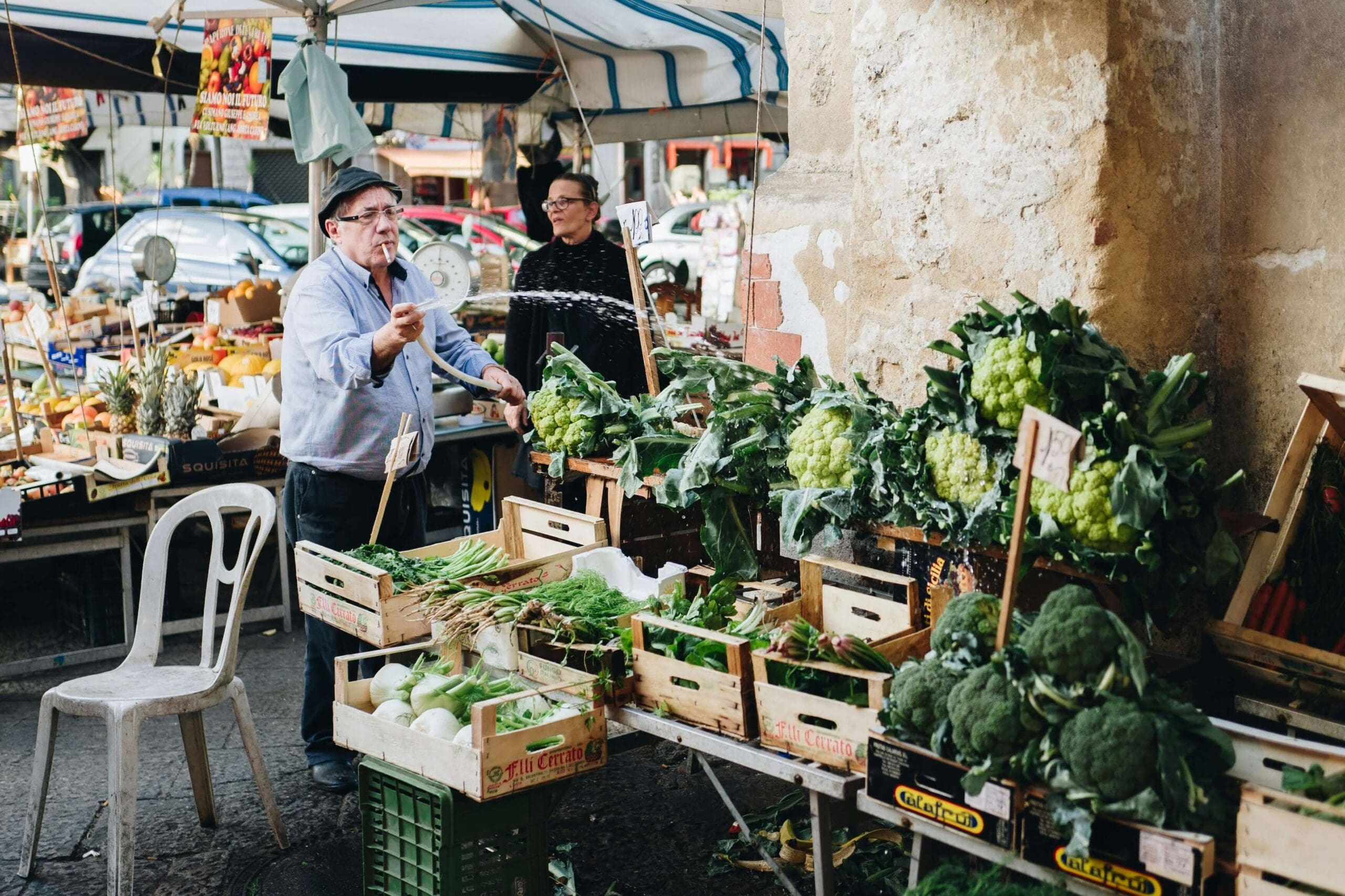
Western Sicily carries stronger Arab and Spanish influence. Couscous appears as tradition rather than curiosity, particularly around Trapani. Sweets grow more elaborate. Spices and dried fruits appear more frequently. Palermo’s markets compress this complexity into a few crowded blocks, where fried snacks, offal, chickpea fritters, and pastries coexist without hierarchy.
By eating regionally rather than chasing signature dishes everywhere, the island’s uneven historical settlement becomes clear.
The Family Table as Cultural Archive
To understand Sicily beyond its public face, you have to look past restaurants and into the rhythms of family life. Restaurants show how Sicily presents itself. Families show how it endures. Sicilian food culture remains deeply domestic, shaped less by written recipes than by repetition and instinct. Knowledge is passed through observation and correction, learned by doing rather than documenting.
The anchor of this continuity is the family meal, particularly the Sunday lunch that still structures the week in many households. These meals unfold slowly, often across multiple courses and generations, with no urgency to finish. Tomato sauce begins simmering early in the morning, filling the house long before anyone sits down. Nothing about the meal feels performative, yet everything about it reinforces belonging through familiarity.
Holidays and feast days make this relationship between food and time even clearer. Certain dishes appear only once a year, and their absence the rest of the calendar is part of their meaning. Buccellati at Christmas, cassata at Easter, marzipan fruits on All Souls’ Day. These foods require effort precisely because they are not everyday meals. Preparing them marks time and reinforces memory through labor.
In these kitchens, cooking functions as quiet storytelling. Each dish carries references to hardship, celebration, and adaptation. Children learn not only how to cook, but when to cook certain foods and why. Through family cooking, food becomes calendar, inheritance, and collective memory, preserving Sicily’s past as part of daily life rather than something set aside.
Sweets as Historical Record
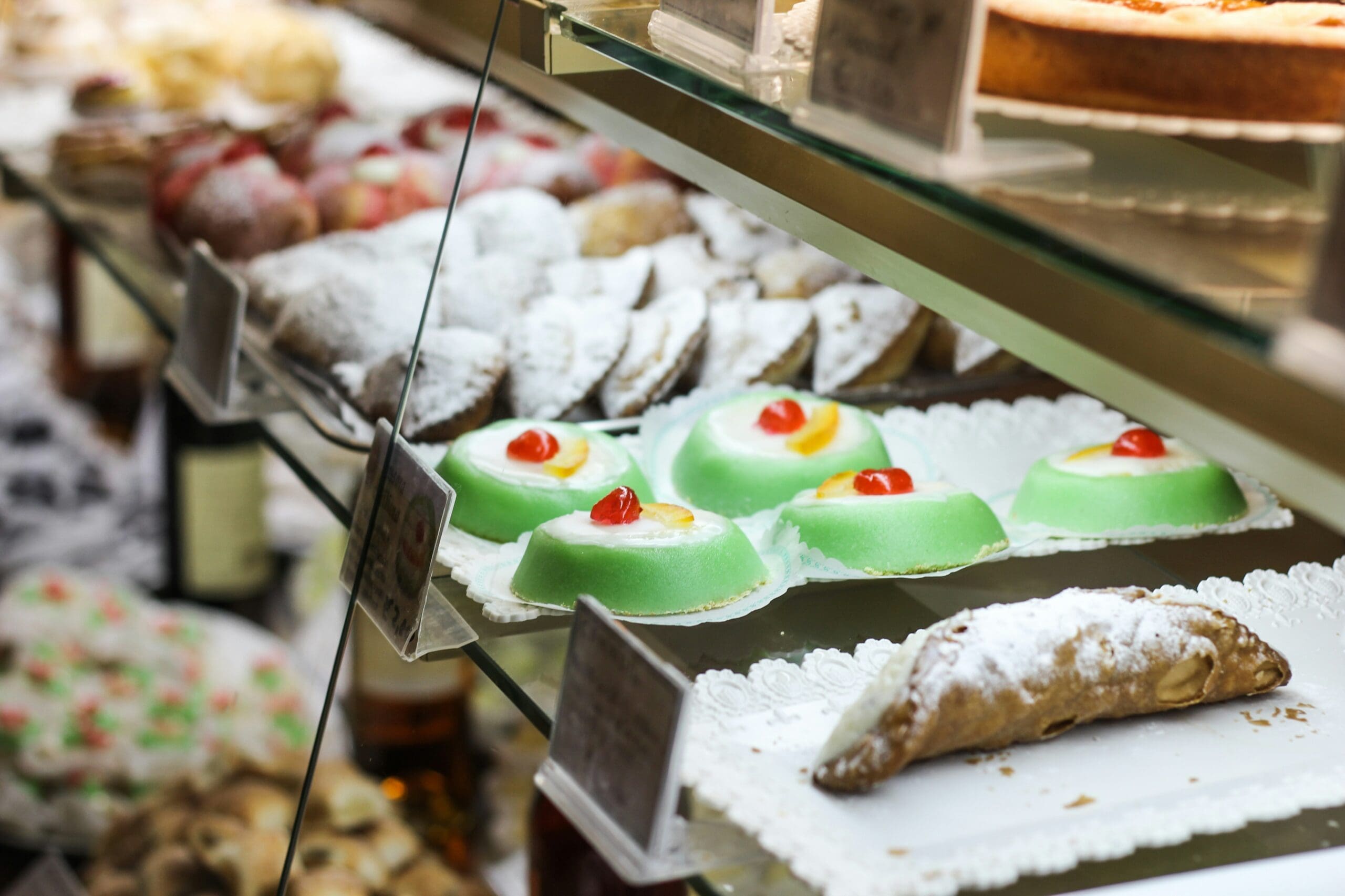
Sicilian desserts preserve history in some of its most concentrated forms. Cassata, with its layers of ricotta, sugar, almonds, and candied fruit, reflects centuries of influence compressed into a single object. Ricotta points back to pastoral Greek traditions, while sugar and almonds arrived through Arab cultivation. The elaborate decoration and structure were refined in convent kitchens under Norman and Spanish rule. Its visual richness mirrors Sicily’s baroque architecture, where excess is not ornamental but expressive.
Cannoli offer the same history in a more portable form. Fried dough filled with sweetened ricotta, often accented with citrus peel or cinnamon, blends pastoral life with Moorish sweetness. Legends trace their origins to Arab courts and later convents, but the flavors themselves explain the lineage without commentary.
Granita, still eaten for breakfast in eastern Sicily, expresses geography and climate more than indulgence. Almond, lemon, pistachio, or coffee granita paired with brioche reflects heat, agriculture, and daily rhythm. It exists because the land and weather demand it, not because it follows fashion.
Street Food as Social History
Sicilian street food reveals a culture shaped by necessity and ingenuity. In Palermo’s markets, arancini speak to Arab introduced rice and saffron, shaped into something practical and sustaining. Pane ca’ meusa preserves Jewish culinary ingenuity, transforming offal into nourishment during periods of scarcity. Panelle descend from Arab chickpea flatbreads, fried and eaten daily with no ceremony attached.
These foods are eaten standing, often quickly, and without distinction between who they are for. They belong to everyone. By eating where locals eat and how they eat, visitors move briefly inside Sicily’s social fabric rather than observing it from the outside.
Wine as Landscape and Memory
Wine completes the cultural picture. Sicilian viticulture dates back to Greek colonists, but its diversity reflects the island’s varied terrain rather than a single tradition. Nero d’Avola expresses heat, sun, and southern plains. Wines from Etna speak of altitude, volcanic soil, and restraint. Carricante and Nerello Mascalese convey tension and minerality more than power.
Sweet wines such as Marsala, Malvasia delle Lipari, and Passito di Pantelleria tell stories of trade, isolation, and preservation. Wine evolved alongside food, not separately from it. Pairings emerged through use rather than theory, shaped by balance and habit.
At the table, wine functions less as performance and more as conversation, reinforcing Sicily’s preference for shared experience over display.
How to Experience Sicily (and Anywhere) Through Its Food
Experiencing Sicily through food does not require encyclopedic knowledge or rigid planning, but it does require intention. The goal is not to seek out the most famous dishes or the most celebrated tables. It is to use food as a way to read the place as it unfolds around you.
Begin early in your stay. Food works best as orientation, not as a reward at the end of a day. Markets, bakeries, and cafés offer immediate context. A morning espresso at the same bar two days in a row will teach you more about local rhythm than a packed sightseeing schedule. Repetition builds familiarity quickly.
Eat by the clock rather than against it. In Sicily, meal times are not suggestions. Aligning yourself with them changes how the day feels. When you eat when locals eat, the place begins to make sense on its own terms.
Let seasonality guide decisions. Sicilian menus are often shorter than visitors anticipate, and that is intentional. Ordering what is abundant in the moment offers a clearer sense of place than chasing a specific dish you read about beforehand.
Eat regionally. Sicily is not a single culinary landscape. Let geography determine what you eat. Moving across the island with attention to these shifts allows history to surface naturally.
Balance restaurants with informal eating. A seated meal and a paper wrapped street snack belong equally. Each teaches something different.
Return to the same places. Familiarity builds quickly through food. Small rituals anchor you. They also open doors.
Above all, allow food to shape the trip rather than fitting it into the margins. When meals become fixed points rather than afterthoughts, the entire experience slows, deepens, and begins to cohere.
Why Food Creates Faster Understanding
Food collapses the distance between past and present. It demands presence. One can argue taste anchors memory more powerfully than images or facts. Long after monuments blur together, flavors remain distinct.
In Sicily, food explains how history lives inside daily life. It reveals why time moves differently, why contradiction is tolerated, and why continuity matters more than efficiency. To understand Sicily, you do not need to see everything. You simply need to eat attentively, with context and curiosity.And once you experience how quickly food unlocks a place, you begin to realize that knowing what to eat is only part of the equation. Knowing when, where, and why matters just as much. That deeper understanding rarely happens by accident. It comes from seeing the patterns, understanding the rhythms, and letting the place guide you, often with a quiet nudge from someone who already knows how to read it.