Trying to capture the essence of Sicily in a single article is, realistically, impossible. This island does not present itself as a fixed idea that can be summarized or neatly defined. What Sicily offers instead is a feeling that emerges slowly, shaped by patience and time spent without agenda, until one day it becomes clear that understanding has arrived not through effort but through familiarity. Sicily is not a place you decode or master. It is a place you settle into.
The island is often described as intense, layered, or chaotic, and while those descriptions are not incorrect, they rarely explain what it feels like to actually live within Sicily’s tempo. What many visitors miss is that Sicily is not meant to be consumed quickly or understood all at once. It reveals itself through rhythm rather than spectacle, through ordinary days rather than highlights, and through the spaces between events rather than the events themselves. Understanding begins not by doing more, but by doing less and staying long enough to notice what fills the quiet.
This becomes especially clear once you move beyond the parts of the island that are designed for easy consumption. Inland towns, the west coast, and Palermo ask for a different kind of attention, one that values exploration over novelty and presence over performance. These places are less concerned with being seen and more interested in being lived in, which is why Sicily never feels as though it is trying to impress you. It simply is itself.
The Shape of an Ordinary Day
Daily life in Sicily unfolds slowly, but never passively. This distinction becomes apparent early in the morning, particularly outside the cities, where agricultural work begins before the heat settles in. Bars open their doors for espresso and conversation, and people move with intention instead of urgency; something that often feels unfamiliar to visitors accustomed to urgency as a default setting.
As the morning progresses, the rhythm begins to shift, especially during the warmer months, when activity gradually moves inward as the heat builds. Shops close, doors shut, and streets empty in a way that can initially feel like inconvenience to outsiders, yet this pause is not a breakdown in momentum but a form of structure. The day is designed around climate, labor, and pleasure rather than productivity for its own sake, and slowing down is not a failure of efficiency but an adjustment that makes the rest of the day work better.
Afternoons stretch as time becomes more flexible, and although very little appears to be happening on the surface, this stillness is deceptive. Meals are being prepared slowly, work resumes quietly behind closed doors, and conversations extend without urgency, creating a sense that life is bending toward enjoyment rather than output. For travelers arriving from cultures built around speed and constant motion, this shift can feel disorienting at first, but it often becomes one of the most appreciated changes once resistance fades.
Evening arrives gradually rather than abruptly, as towns reopen, people reappear, and social life expands outward into piazzas, sidewalks, and long dinners that are not rushed toward conclusion. Conversation takes precedence over schedules, connection becomes the point rather than an accessory, and after a few days it becomes clear that Sicily is not slow in the way it is often described. It is deliberate.
What Shapes the Rhythm
Geography plays a central role in shaping this cadence, particularly in western Sicily and the interior, where towns are spread out and roads curve rather than cutting directly from one point to another. Movement takes time here, and that time reshapes expectations. Days should not be stacked with activities but sequenced carefully, allowing space between places to become part of the experience rather than something to minimize or rush through.
Agriculture reinforces this structure in ways that are both visible and deeply ingrained. Vineyards, olive groves, wheat fields, and citrus farms dictate seasonal patterns that still guide daily life, with work following the land and meals following the harvest rather than the clock. There is a clear alignment between what is grown, when it is eaten, and how the day unfolds, making it difficult to separate living from eating, as both belong to the same system.
History also lingers close to the surface, shaping daily life without needing to announce itself. Centuries of occupation, governance, and cultural exchange did not disappear from Sicily, but instead settled into routine, visible in architecture, audible in dialect, and felt in how people relate to authority, family, and outsiders. Nothing feels rushed because nothing feels provisional, and the island has already seen too much to hurry.
Palermo as a Counterpoint
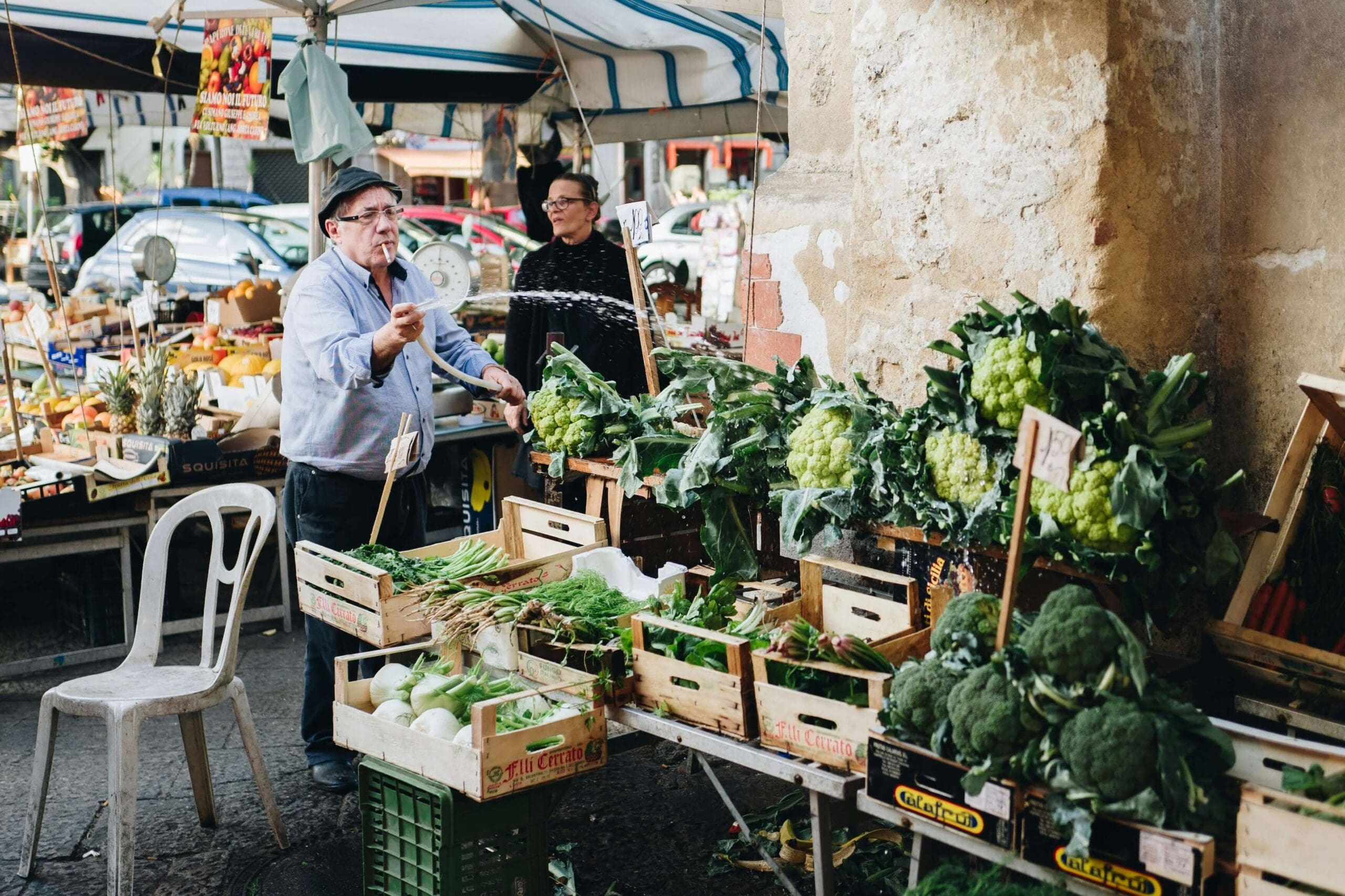
Palermo operates on a different frequency, yet it belongs fully in this conversation because it offers one of the clearest windows into the soul of the island. The city is dense and alive, louder and messier than much of the countryside, with markets spilling into the streets, traffic moving according to its own internal logic, and contradictions existing side by side without apology. For many visitors, the pace can be shocking at first, often in the best way.
Even here, rhythm asserts itself. Mornings are active and social, afternoons slow just enough to make room for lunch, and evenings belong to food and gathering in a way that mirrors the countryside, only amplified. What surprises many people is how quickly Palermo begins to feel familiar, as chaos gives way to routine and corners become landmarks through repetition. Daily rituals, whether returning to the same bar for espresso or walking the same route home, create a sense of grounding that reveals itself only through time.
Palermo cannot be understood immediately, and any attempt to do so usually ends in frustration. The city requires you to stay long enough to stop resisting it, at which point its logic begins to feel less chaotic and more relational.
Food as a Measure of Time and Place
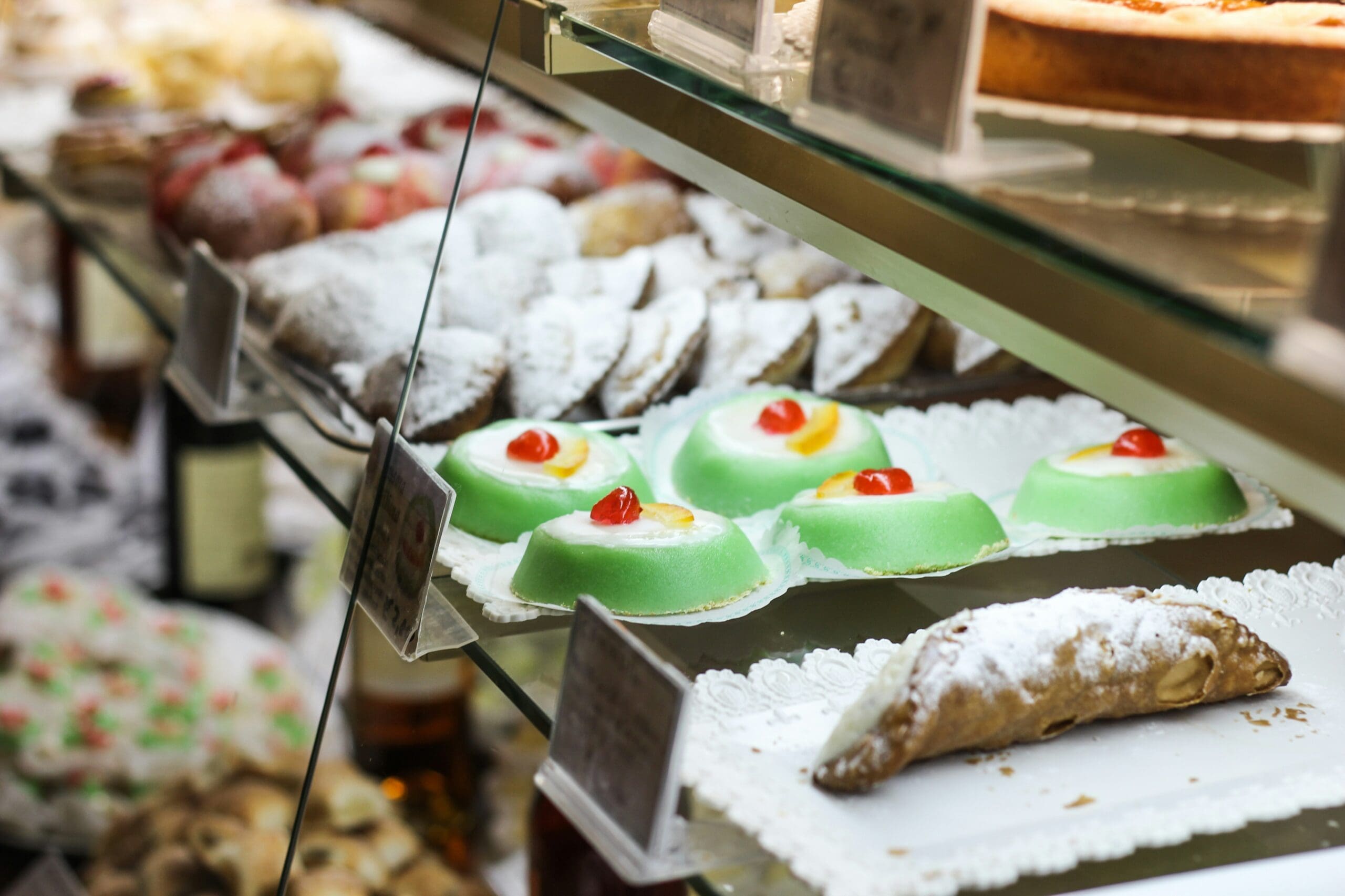
Food is one of the clearest markers of time and place in Sicily, not because it is elevated or performative, but because it is woven directly into the rhythm of daily life. Meals structure the day, ingredients reflect the land, and recipes carry memory forward without needing explanation.
Sicilian food does not fit neatly into what many travelers recognize as Italian, largely because centuries of conquest shaped a cuisine that blends North African, Spanish, and local traditions into something entirely its own. Caponata reflects sweet and sour flavors introduced during Arab rule, while asstratu (sun-dried tomato paste) traces back to ingredients brought from the New World by the Spanish. To eat in Sicily is not to sample history as a concept, but to taste it as something still alive and ordinary.
Movement, Time, and Social Life
Movement across Sicily follows the same logic as the rest of daily life, in that it is rarely direct and almost never rushed. Roads curve, towns sit apart, and travel requires commitment rather than casual passing through, which changes how distance and effort are perceived. A short drive becomes an experience, and an errand becomes a reason to stop, shifting attention toward what happens along the way rather than what comes next.
Social life mirrors this elasticity. Plans remain loose, invitations evolve, and time alters depending on who is present, making connection more valuable than efficiency. Visitors who attempt to control this rhythm often feel frustrated, while those who adapt tend to feel welcomed, eventually realizing that Sicily is not disorganized but relational, with days bending around people rather than schedules.
What Visitors Often Misunderstand
Many misunderstandings arise when visitors expect Sicily to behave like somewhere else, particularly mainland Italy or places shaped by efficiency as a primary value. They arrive anticipating punctuality where flexibility is valued, clarity where ambiguity is accepted, and responsiveness where patience is expected, and when those expectations are unmet, delays feel personal and silence feels like neglect.
What reveals itself slowly is that Sicily is not asking to accommodate the visitor. It is asking for patience. In return, it offers access to a deeper version of itself, one that does not reveal itself to those passing through quickly or insisting on control.
Why Pace Matters
Experiencing Sicily well requires restraint rather than ambition. The most successful time on the island is not built around coverage, but around immersion, with fewer bases, longer stays, and days that are allowed to unfold without pressure. Movement becomes intentional rather than constant, familiarity is encouraged through repetition, and planning exists to protect rhythm rather than to fill space.
Sicily does not reward urgency, but it consistently rewards presence. After a few days, the island begins to feel less foreign, and what emerges is a sense of belonging that has nothing to do with fluency or mastery. Understanding Sicily’s rhythm shifts the goal from seeing to settling in, from managing time to inhabiting it.
That shift matters, because Sicily offers something increasingly rare: a way of life that has resisted compression and still moves according to its own internal logic. To experience that fully, you do not need more plans.
You need the right pace.