What it is, how it works, and why the Amazon is one of the most compelling arguments for it.
Chances are, most people who say they don’t like cruising have never been on a ship carrying fewer than a couple hundred passengers. The objection to cruising is understandable, because what they’re imagining is real: a floating resort, the atrium with the waterfall, the breakfast buffet stretching the length of a football field. That version of cruising exists, and for a certain kind of traveler it works perfectly well. But it has almost nothing in common with what happens aboard a small luxury vessel. The two experiences share a name and very little else.
The scale changes everything. On a ship carrying 40 guests, you are not navigating crowd management. You are not competing for a deck chair or waiting in line for a tender. The ratio of crew to guests on a well-run small ship is often close to one to one, which means that service is attentive without being performative, and that the people looking after you know your name by the second morning. What emerges over the course of a few days is less like a hotel and more like a private gathering, where the logistics disappear and the experience becomes the focus.
The social dimension also feels drastically different. On a larger ship, you can spend an entire voyage without recognizing a face. On a small ship, you see the same people at dinner, on the skiff, at the morning briefing. For travelers who are open to it, this produces a kind of easy camaraderie that’s hard to manufacture in larger settings. For those who prefer their own company, the staterooms on certain small vessels are luxurious retreats, and no one is obligated to be social.
The food on these ships is another reliable distinction. There are no buffets, no themed dinner nights, no catering-scale compromises. The galleys are small and the menus are specific, often built around the regional culinary traditions and what’s available locally. A curated small ship doesn’t try to be all things; it feeds you well in a way that is connected to where you are. That connection between place and plate is something larger ships, by necessity, give up.
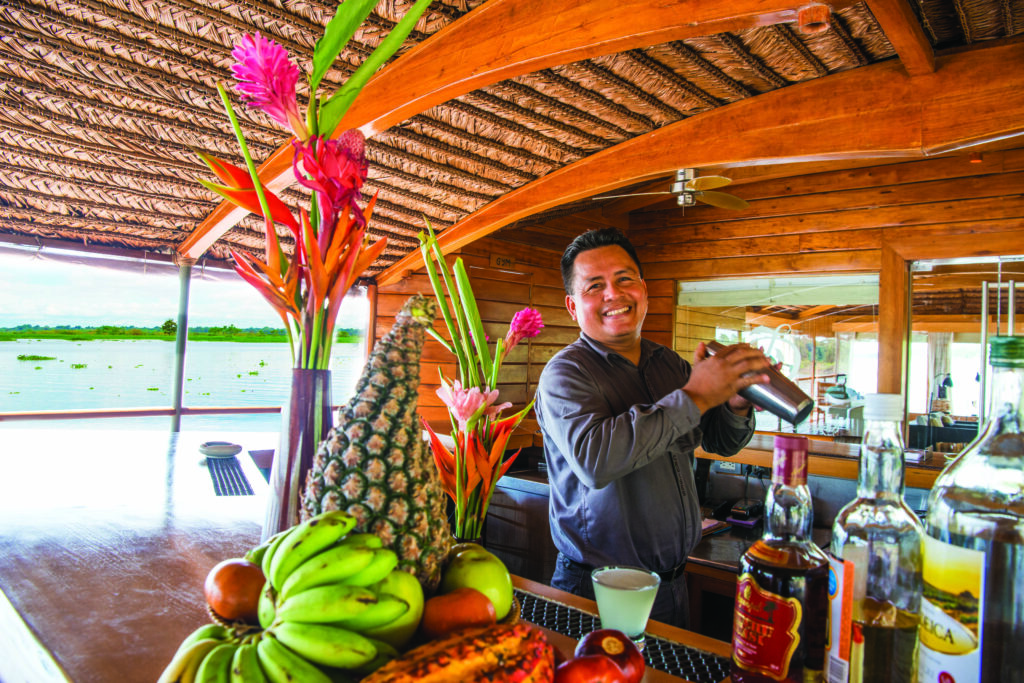
Then there is the question of where a small ship can actually go. This is perhaps the most significant distinction. A vessel carrying 40 passengers draws far less water than one carrying 3,000, which means it can navigate river systems, shallow coastal passages, and protected anchorages that are simply inaccessible to the major cruise lines. This isn’t a minor advantage. It determines the entire nature of the journey. In some regions, the destination is only reachable by a ship of this size, which means the experience of being there isn’t shared with another vessel on the horizon, or another group of passengers arriving by tender.
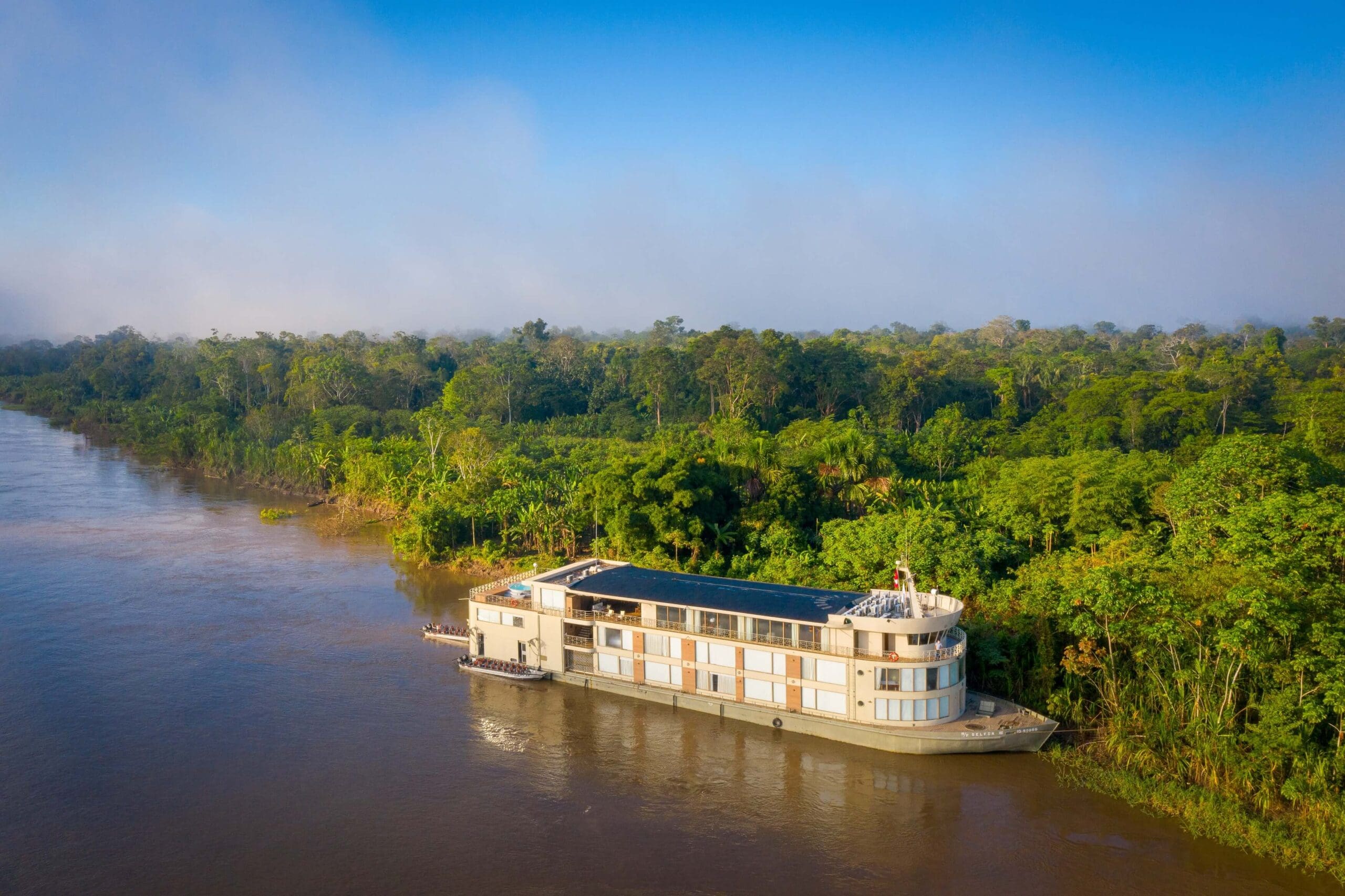
The Delphin III meets these qualifications and more. Owned by Delphin Amazon Cruises, a Peruvian company founded specifically to operate in the Upper Amazon, the ship carries 42 guests through the Ucayali and Marañón rivers into the Pacaya-Samiria National Reserve. It’s chartered by a select group of luxury expedition operators, among them Lindblad Expeditions-National Geographic, whose long-standing presence in the region and partnership with the vessel reflects a mutual high standard. The reserve itself is one of the largest protected areas in South America, and it’s the kind of place that doesn’t accommodate large-scale tourism by design or by geography. Getting there requires a ship that fits the river, and a program that fits the place.
The Delphin III was locally built, carries a crew of 30, and was inducted into the Relais & Châteaux group in recognition of its commitment to local nature, culture, and its Amazonian-Peruvian cuisine. That the ship earned this recognition independently, before being sought out by operators of Lindblad’s caliber, says something about where it sits in the market. Relais & Châteaux is a standard that requires specificity of place, quality of cuisine, and genuine integration with the surrounding environment. The ship’s interiors feature hand-made furniture, art, and textiles sourced from surrounding communities, not as decorative concepts but as genuine support of the regional supply chain. The 22 suites are wrapped in floor-to-ceiling, wall-to-wall windows, which on a rainforest river means the jungle is always present, whether you’re lying in bed at dawn or sitting down to dinner in the evening.
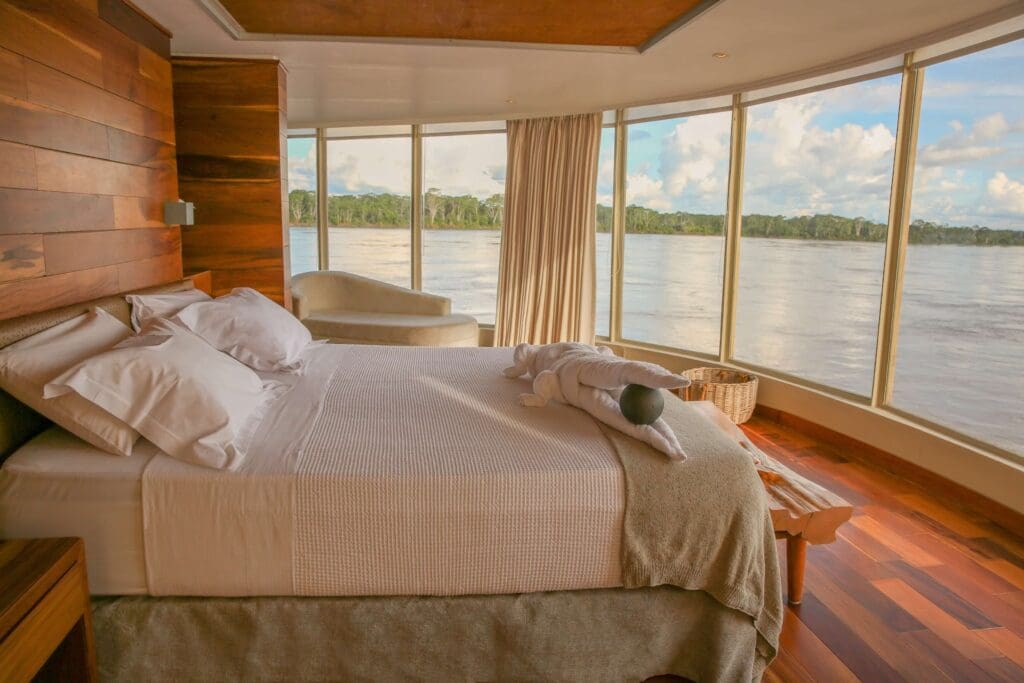
The suite categories vary in scale, but the quality is consistent throughout. Every cabin is equipped with spa-quality bath amenities, luxury cotton linens, premium mattresses, and individual climate control. The Andes Suite at the bow, at 597 square feet with 180-degree wraparound windows and a clawfoot bathtub, is the kind of room that makes retreating to your stateroom genuinely appealing rather than simply tolerable. On a journey this immersive, and with the Amazonian climate, that matters. You want to be able to step back from the environment, absorb what you’ve seen, and return to the river the next day refreshed.
What Lindblad and National Geographic bring to the partnership is the expedition infrastructure. Every voyage includes naturalists, certified photo instructors, and local guides who have spent careers in this specific ecosystem. The morning briefing is not a ship-board formality; it’s a working session that shapes how you’ll spend the next several hours. The ships are the only Amazon vessels in Peru with their own kayak fleets, and all cruises are accompanied by certified wildlife experts. The naturalists and expedition leaders on these voyages have in some cases spent decades working the Upper Amazon, and that depth of knowledge changes what’s possible in the field. Moving through a flooded forest with a local ecologist who knows the bird calls, the insect populations, and the seasonal flooding patterns results in a deep understanding of the area, one that doesn’t come when you are 1 out of 3,000 on a larger ship.
A day on the Delphin III follows a natural rhythm rather than a fixed schedule. The program takes you out into the tributaries by skiff in the cooler part of the morning, moving quietly through waterways where pink river dolphins surface casually and sloths hang in the upper canopy, barely distinguishable from the surrounding leaves. The scale of the reserve means you can travel for hours without seeing another vessel. That absence is not incidental. It’s the condition under which this kind of journey is possible, and it’s what separates the Delphin III’s reach from any expedition operating on a larger footprint.
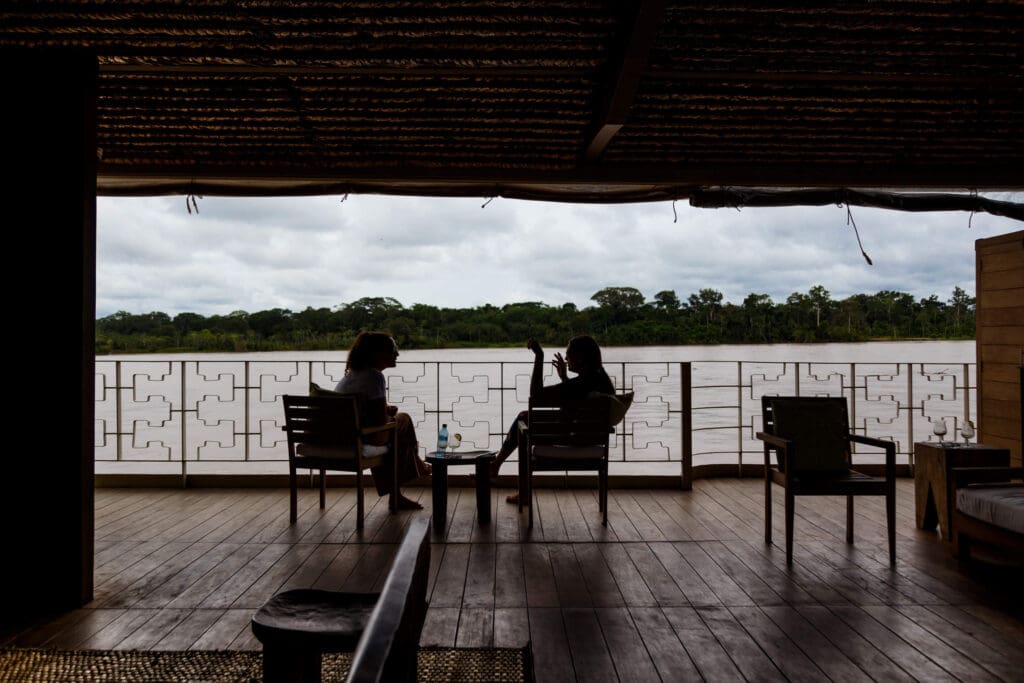
By late afternoon the ship is back at anchor, and the pace slows. The observation deck with its open-air whirlpool offers a different vantage on the river, and the lounge fills for the evening naturalist presentation, which tends to function as a way of making sense of the day’s encounters, giving them context and connecting individual observations to the larger biology of the region. Then dinner, which aboard the Delphin III is a truly considered meal. The kitchen works with Amazonian-Peruvian ingredients, and the result is cooking that is specific to where you are rather than generic or catered to an international clientele. A glass of wine while looking out onto the river at dusk, with no other light visible in any direction is something that’s increasingly rare in well-traveled circles: genuine solitude in a genuinely remarkable place.
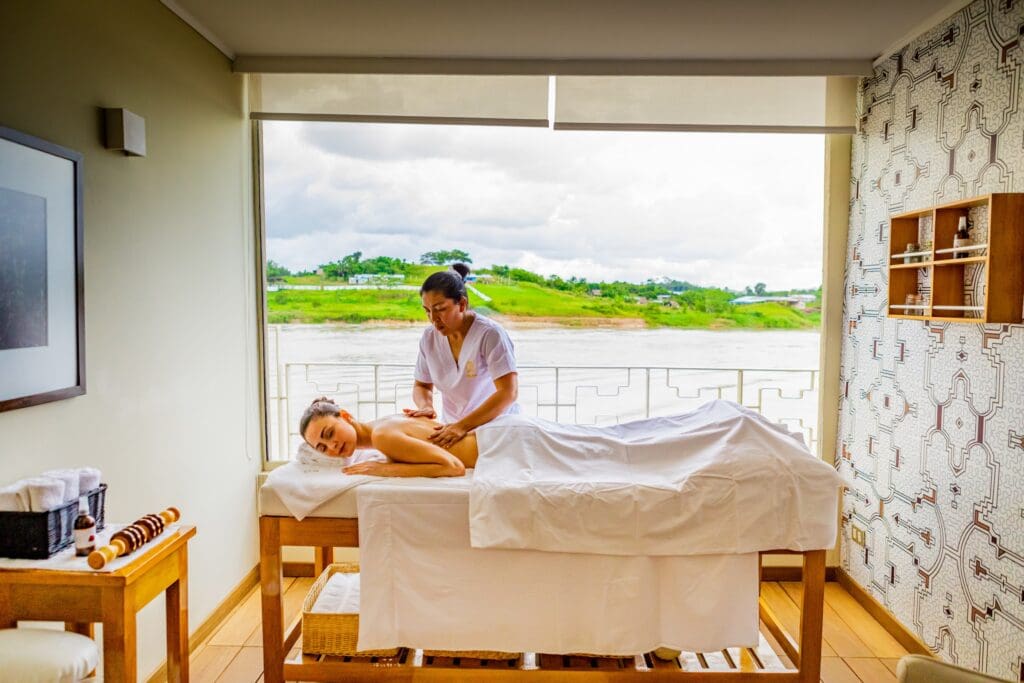
The Lindblad-National Geographic partnership also carries a conservation dimension that speaks to the seriousness of the operation. Through the Lindblad Expeditions-National Geographic Fund, nearly $500,000 has been invested in regional conservation projects, including work with local communities on forest conservation, eco-entrepreneurship, and reforestation. The river communities visited throughout the itinerary are partners in the program. That integration, between the ship, the science, the local expertise, and the communities along the reserve, is what gives the experience its coherence. It’s the difference between a well-appointed trip to a remarkable place and one that’s been genuinely thought through.
Small ship cruising isn’t for every destination, and it isn’t for every traveler. But for those who’ve spent years assuming that cruising isn’t for them, it’s worth understanding that the format they’re picturing and the format described here have almost nothing in common. The Amazon, in particular, doesn’t lend itself to another approach. The river sets the terms.
Expedition cruising is one of the formats I work with often, and the Delphin III with Lindblad is among one of my clients’ favorites. If you’re curious whether it might be the right fit for where you are in your travels, I’m happy to talk through what the experience looks like in practice and how it might sit within a broader Peru or South American itinerary.