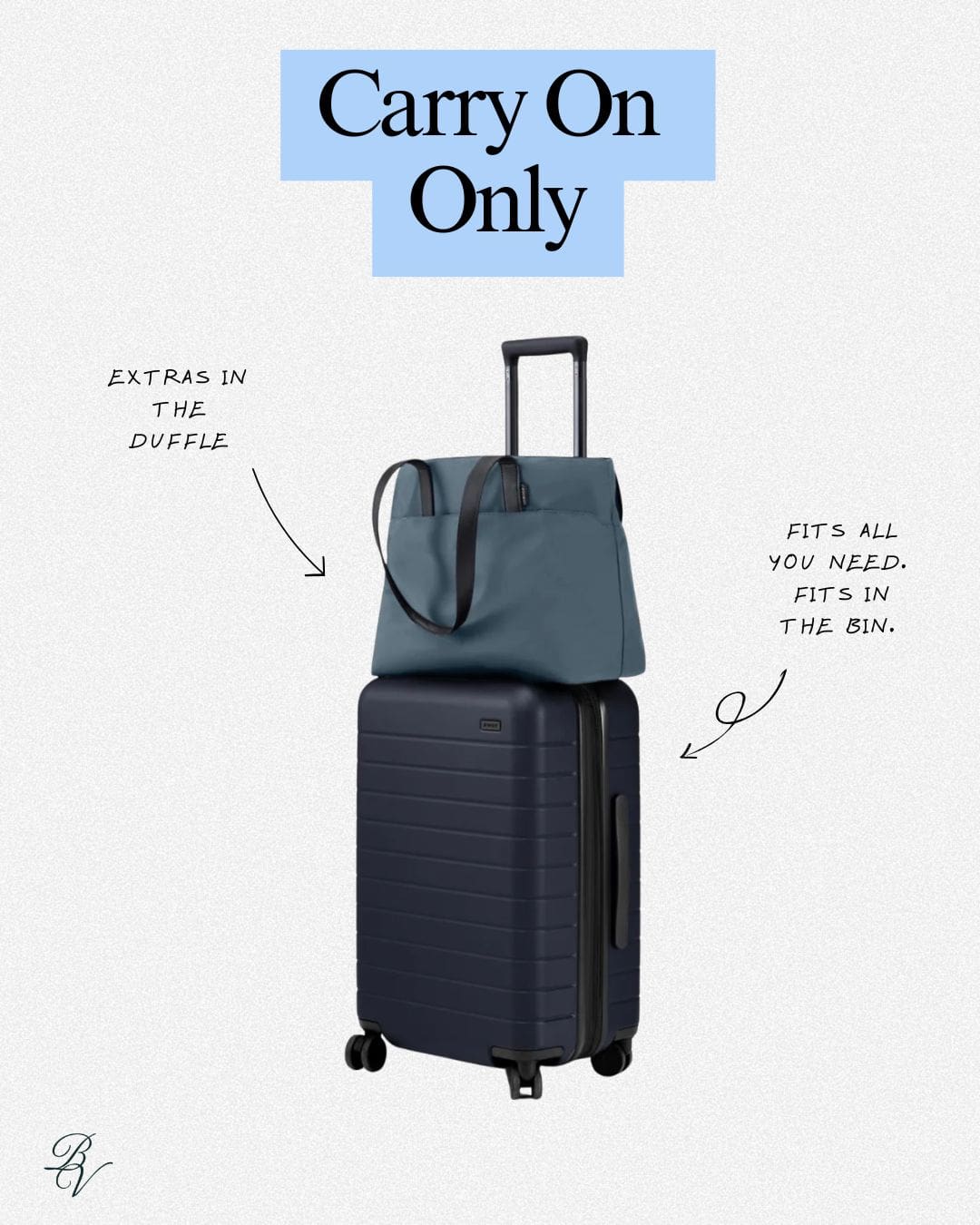
How carry-on travel changes the way a trip feels, from the moment you land to the moment you leave
There’s a particular kind of confidence that comes from walking off a plane with everything you need. No carousel wait, no claim ticket, no forty minutes watching other people’s luggage circle past. For trips in the right range, checking a bag is often just a habit rather than a necessity, and once you’ve broken it, it’s difficult to go back.
The carry-on approach works well for trips between four and ten days (I have been known to push it to a month). Below that threshold, almost anyone can manage it without much thought. Above it, the math starts working against you, particularly if you’re moving between climates, attending anything formal, or spending more than a week without access to laundry. It also doesn’t work well for trips built around gear. A ski week, a safari with strict weight limits on bush planes, a serious hiking itinerary where boots and a rain shell are non-negotiable, these trips require a checked bag and there’s often no way around that. The same is true for any itinerary spanning more than two or three distinct dress codes. Trying to compress a formal dinner and a walking-heavy travel day into a single carry-on is the kind of optimization that turns packing into its own project and usually produces a bag that technically fits in the overhead bin but doesn’t work once you arrive.
For everything else, the constraint of one-bag-travel is genuinely useful. It forces decisions that most people benefit from making anyway.
What makes carry-on travel function at a certain level isn’t minimalism for its own sake. It’s building a bag around a clear color logic, so that every piece connects to at least two others and nothing is meant for a single occasion. This sounds straightforward but most people pack around individual outfits rather than around a system, which is why they end up with a full bag and still feel like they have nothing to wear. A navy linen shirt that works for dinner in Puglia, a winery visit in the afternoon, and a boat the next morning isn’t a compromise. It’s just a well-chosen piece doing what a well-chosen piece should do. If you feel the need to branch out, as I often do – color! Patterns! – do so with accessories. Silk scarves take up zero space and are basically a non-negotiable for most European destinations anyways.
Fabric matters considerably more when you’re working within limited space. Natural fibers, particularly merino wool and linen, travel well because they breathe, they release odors between wearings, and they tend to look intentional even when slightly wrinkled. However, a linen shirt that looks relaxed and considered in Palermo looks like a wrinkled shirt in a business context, so the destination shapes which fabrics make sense. For most warm weather or Mediterranean itineraries, linen and light cotton do the work. For shoulder season travel in northern or central Europe, a mid-weight merino is among the most versatile things in the bag. It packs small, layers cleanly under a jacket, and reads appropriately across a wide range of settings.
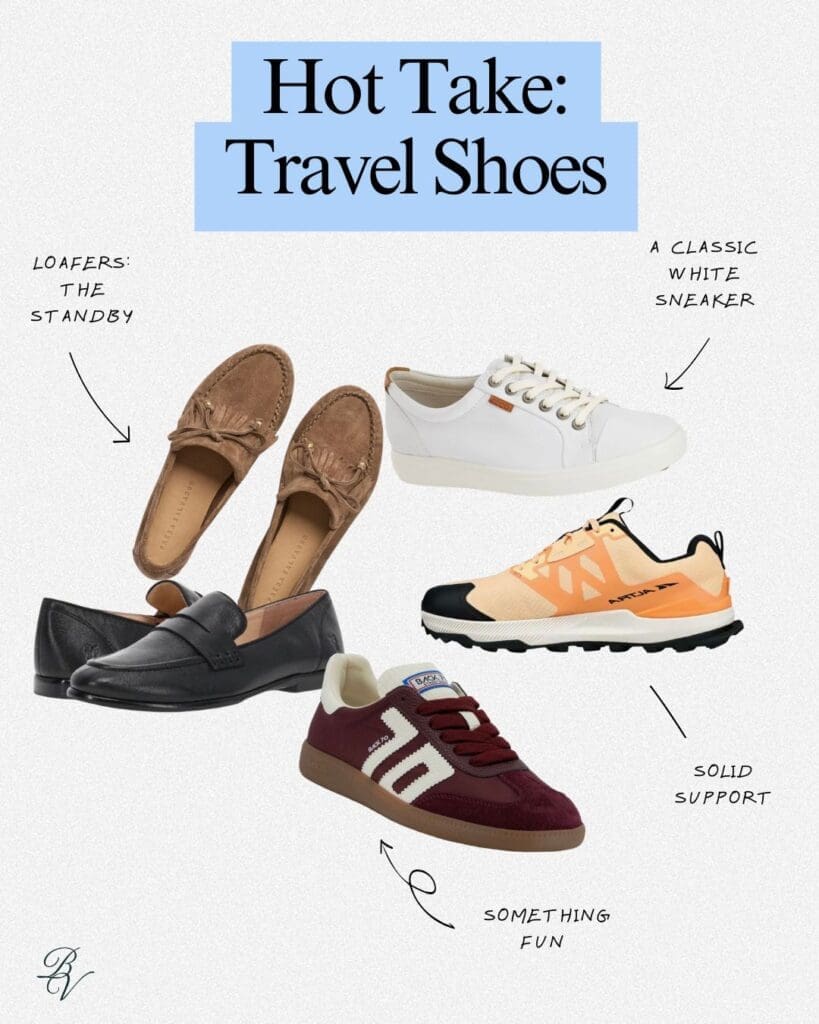
Shoes are where carry-on packing either holds together or falls apart, and the reason is simple: they’re dense, they don’t compress, and they set the bar for everything else. Two pairs is the workable number for most trips of this length. One that handles real walking and reads as smart casual in a relaxed dinner setting, and one that’s appropriate for an evening without destroying your feet on uneven stone. Three pairs is where the bag starts feeling full before clothes go in, and the third pair almost always ends up being the one you wear least. These are the shoes currently in my rotation: Back 70 Cloud, Eco 7, Altra Lone Peak, fun loafers, classic loafers.
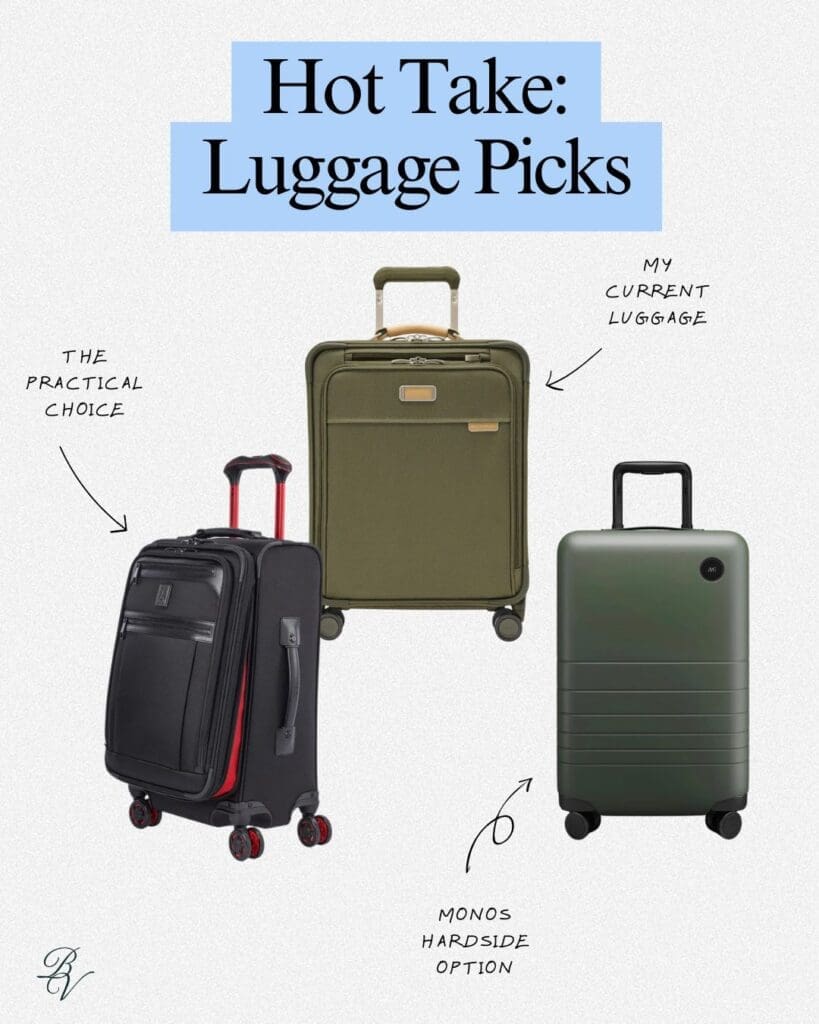
The bag itself matters more than most people acknowledge before they’ve had one gate-checked. The difference between a carry-on that fits reliably in every overhead bin and one that technically meets airline dimensions but causes problems on smaller regional aircraft often comes down to a few centimeters and whether it has a rigid external frame. If I needed a new one I would consider: Travel Pro Platinum Elite, Briggs & Riley Baseline (what I currently have), Monos. Packing cubes help more than expected, not because they create space but because they create organization, and organization is what makes a compact bag feel manageable rather than frustrating at six in the morning. These Monos ones are practical, but these cuties just went in my cart.
The way a trip’s context shapes what needs to be in the bag is worth thinking through before you start pulling things from the closet. A beach-focused week in the Caribbean or Mediterranean is actually one of the easier carry-on scenarios, because the dress code is compressed and the range of occasions is fairly narrow. Days run casual and evenings rarely require much beyond something that looks intentional and travels without a steamer. The complication is usually volume rather than versatility: swimsuits, coverups, and sandals take up space without folding small.
Italy and southern Europe present a different kind of challenge, one that’s less about volume and more about reading the room correctly. The contexts shift quickly and sometimes within the same afternoon. A morning at a market in a small hill town, lunch at a restaurant where the tablecloths are pressed, a visit to a church that requires covered shoulders, and an aperitivo at a bar where people have clearly thought about what they’re wearing. The bag that handles all of that without feeling like a compromise usually has one piece doing real structural work, a blazer, a well-cut linen layer, something that anchors whatever it is paired with. That single piece tends to be worth more than several additional tops.
Shoulder season in Europe is where carry-on packing gets genuinely tested, because the temperature range is real and a coat won’t fit in the bag. The outer layer has to work harder than in any other context, which means it has to be chosen more carefully. A technical mid-layer that looks intentional rather than athletic is the key decision, something that functions as a jacket at fifty degrees and compresses into the bottom of the bag when the afternoon warms up. What doesn’t work is the instinct to bring a beautiful coat and assume it can be checked separately or left at the hotel. That workaround creates its own logistics and tends to complicate the trip in small ways that accumulate. I have a horrible habit of purchasing coats while traveling, but if I were stateside and looking, these would catch my eye: classic trench, crop trench, packable waterproof layer, statement piece.
One thing that consistently makes carry-on travel easier, and that clients often overlook in the planning stage, is building in a laundry refresh midway through. Most good hotels handle it, and in Europe especially, same-day laundry services are easy to find and not expensive. Knowing that’s available changes the packing calculus in a meaningful way. A seven-day bag stretches comfortably to ten, and the choices you make before leaving feel less like rationing and more like editing.
There’s one scenario that changes the carry-on equation on the return trip, and it’s worth planning for before you leave rather than improvising at the hotel. If the itinerary includes serious shopping, whether that’s ceramics in Deruta, olive oil and wine in Tuscany, or clothing in Paris, the bag you arrived with isn’t always the bag that gets you home cleanly. The simplest solution is to pack a lightweight foldable duffel at the bottom of your carry-on before you leave. It adds almost nothing in weight or space, and on the return journey it changes everything. Check your hard-sided carry-on as luggage, transfer what you need for the flight into the duffel, and board with that instead. The checked bag risk that feels unacceptable at the start of a trip is much more manageable at the end of one. You’re going home. A delay is an inconvenience rather than a disruption to plans. The one exception worth noting: anything genuinely irreplaceable, a piece of jewelry, a significant purchase, documents, stays with you regardless of how the rest is organized. The foldable duffel works because it’s flexible, not because it eliminates judgment.
The trips where this approach feels effortless are usually the ones where someone thought carefully before they left, not because they find packing interesting, but because they understand that how you arrive shapes how the first day unfolds. Walking into a hotel in Florence with a single bag and nothing to sort is a different beginning than one that starts with a wait and a claim ticket. That difference is hard to quantify, but it’s easy to feel, and it tends to set the tone for everything that follows.